Common findings on repair verification
These are the repairs we most often find billed in full but not completed to spec.
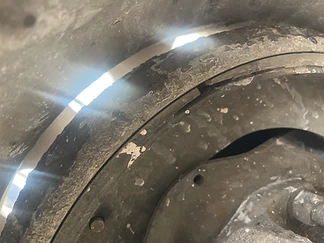
The shoe on the unit after the brake job was billed — lining worn away, metal against the drum.
Brake job billed in full, shoes installed metal-to-metal
What we found: A follow-behind inspection on a completed brake service showed shoes worn to the rivets with heavily scored drums. The invoice listed new shoes, hardware, and drum turning.
Why it matters: The unit was released as road-ready with brakes that would not pass a DOT inspection — a driver and a load put on the highway with no real stopping power.
Video from the unit — the wheel after the vendor's brake replacement, found loose on a post-trip inspection.
Wheel left loose after a vendor brake replacement
What we found: A vendor replaced the brakes on a school bus. The wheel was not installed correctly, it lost its clamp load, and it ran loose. The bus stayed on its route for a couple of days before a post-trip inspection caught it.
Why it matters: This was a public school bus hauling kids. It could have been a lot worse — a wheel that comes off at highway speed does not just end the trip, it endangers everyone around the bus. The only thing that stopped it was someone catching it on a post-trip inspection.
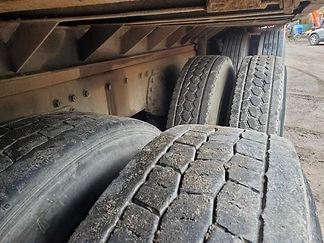
Drive axle on the unit — more than 8/32" of difference between the tires on the same axle.
Drive tires more than 8/32" of difference on the same axle
What we found: Recorded correctly on the PM form: drive tires more than 8/32" of difference from inner to outer. No follow-up was recommended to the customer.
Why it matters: The larger tire travels further in one rotation than the smaller one, causing the smaller tire to skid and heat up — leading to premature wear and tire cupping.

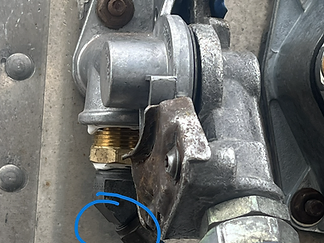
The leaking fitting at the gladhand, circled, on a unit released as road-ready.
Air leak left at the gladhand after a repair
What we found: The tractor passed the static check on paper, but the service line leaked steadily at the gladhand. No leak-down test was documented.
Why it matters: A slow air leak turns into a hard brake application failure under load. This is exactly the kind of shortcut that never shows up until it matters.

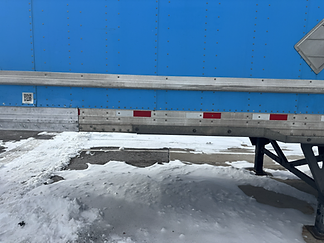
Bottom rail on the trailer — the repair plate and its bolted splice stop in front of the landing gear legs instead of carrying past them.
Bottom rail sectioned in a position that is not DOT compliant
What we found: A bottom rail was sectioned in front of the landing gear. The splice seam and bolted repair plate stop short of the landing gear legs, and the conspicuity tape is broken at the joint.
Why it matters: FMCSA requires a bottom rail section to extend at least 4 feet past the center of the landing gear legs, and to run no more than 75% of the trailer length. This section ends at the landing gear instead of past it, which the rule does not allow. A 3-piece rail with two splices is not acceptable either, and if the damage needs more than 75% the rail has to be replaced entirely — a splice in the wrong place weakens the structure the landing gear and suspension mount to.

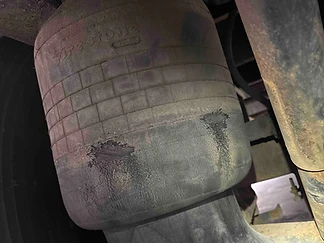
Air bag found on an inspection with multiple issues that were not recorded — the rubber is worn through and the cords are showing.
Air bag with exposed cords never marked as a defect
What we found: This air bag was found on an inspection with multiple issues that were not recorded. The leveling valve had just been replaced and had a plug installed in the exhaust port, so the bag could not deflate — it was over-inflating and holding the ride height too high. The bag itself is worn and the cords are exposed, and it was never marked as a defect.
Why it matters: This bag is going to fail — it is imminent. When it goes, the customer is paying for a roadside service call or a tow, and a truck that suddenly will not drive straight is an accident waiting to happen. The over-inflation also puts the U-joint angle out of spec and wears the driveline prematurely, and it leaves the vehicle running over-height where a bridge or overpass can be struck.

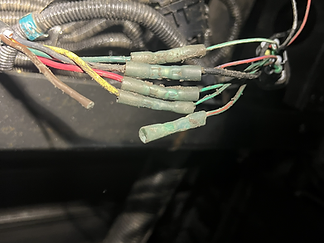
Crimped butt connectors left unsealed, with the marker light wiring broken off the unit.
Trailer light wiring missed on routine annual inspection
What we found: A Samsara unit had been installed on this unit and the wiring for the marker lighting was broken off, along with all other butt connectors being corroded and about to fail, due to the tech not using a heat gun to seal them.
Why it matters: Corrosion and vibration will fail the connection again within months — the same repair gets billed to you a second time.
These are a sample. What we find on your units depends on your vendors, your equipment, and how closely the work was checked the last time it was billed.
Think your units might be in here?
Request an independent inspection and find out what your vendors are actually delivering.